
WiCOR Research Seminar: Moran Frenkel-Pinter
Dr. Moran Frenkel-Pinter, Assistant Professor, Institute of Chemistry, The Hebrew University of Jerusalem
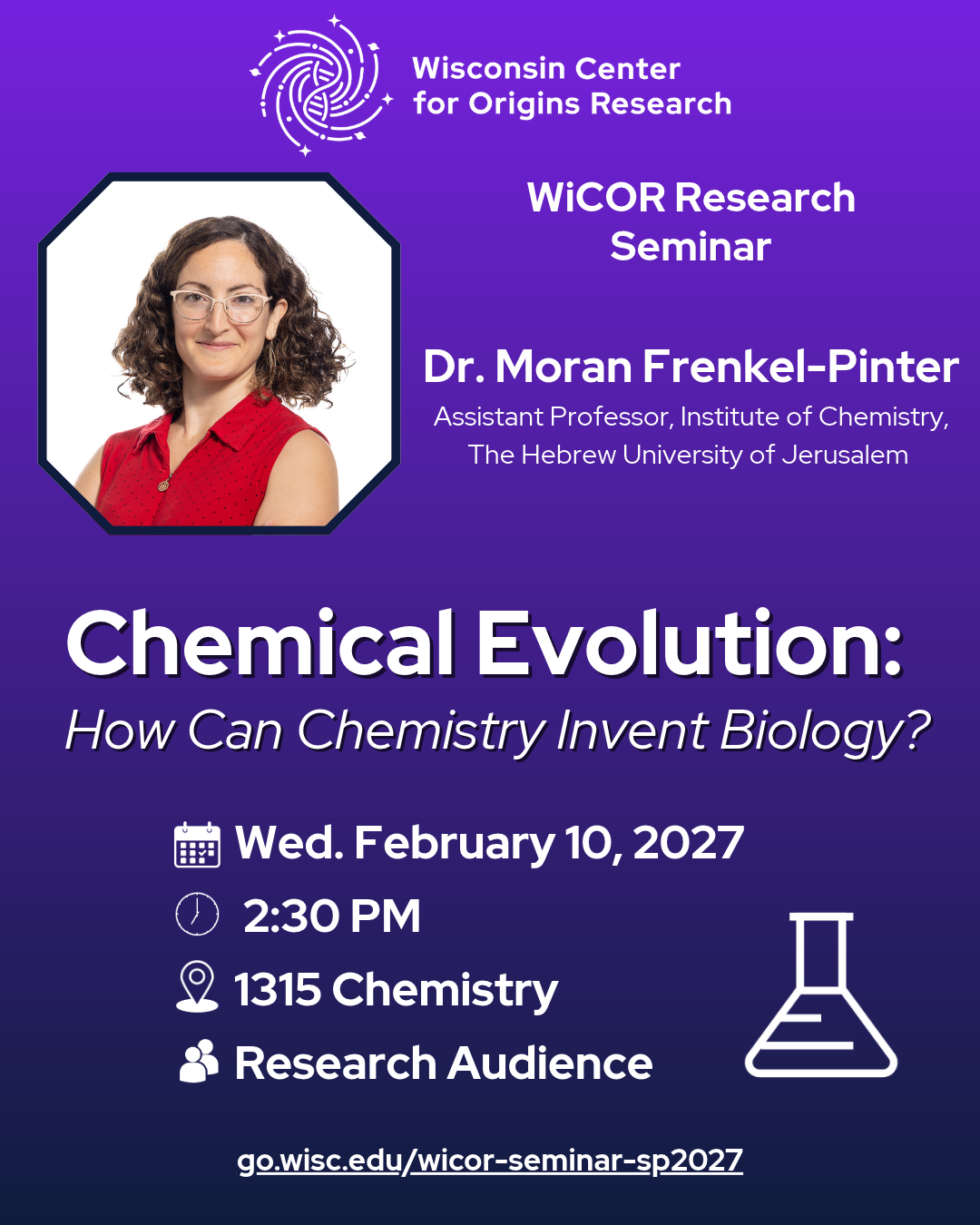
Chemical Evolution: How Can Chemistry Invent Biology?
Abstract:
How did chemistry acquire the capacity for selection, organization, and cooperation before biology existed? Chemical evolution provides a framework for addressing this question by asking how populations of molecules change, interact, and become organized under environmental constraints. In this seminar, I will discuss experimental systems that allow us to probe several possible drivers of this process. I will show how simple prebiotically plausible building blocks can form short polymers, how molecular structure can influence self-assembly and favor certain molecular backbones over others, and how polymerization and compartmentalization can become coupled through cooperative interactions. Together, these examples suggest that chemical reactions, assembly, and compartmentalization are not independent steps, but can act as interacting selective forces that progressively reshape the composition and organization of chemical populations. I will discuss how such processes may help us identify general principles by which chemical systems could have developed some of the properties associated with living systems.
Speaker Bio:
Moran Frenkel-Pinter is an Assistant Professor at the Institute of Chemistry at the Hebrew University of Jerusalem and Deputy Director of the Minerva Center for the Origins of Life. She received her Ph.D. from Tel Aviv University and conducted postdoctoral research at the Georgia Institute of Technology, where she was a NASA Astrobiology Postdoctoral Fellow. Her research focuses on chemical evolution and the origins of life, exploring how simple molecules could have formed increasingly complex and organized chemical systems before the emergence of biology. Her laboratory investigates prebiotic polymerization, molecular self-assembly, compartmentalization, and the chemical processes that may have driven molecular selection on the early Earth. She is the recipient of several awards, including the Stanley L. Miller Early Career Award, the FEBS Excellence Award, an ERC Starting Grant, and the Azrieli Early Career Faculty Fellowship.
Accommodations:
WiCOR is committed to creating an inclusive and accessible event. If you need a reasonable accommodation, please contact Vanessa Orr, WiCOR Administrative Manager, at wicor@wisc.edu. All requests must be made by January 27. We will attempt to implement late requests but cannot guarantee they will be met.