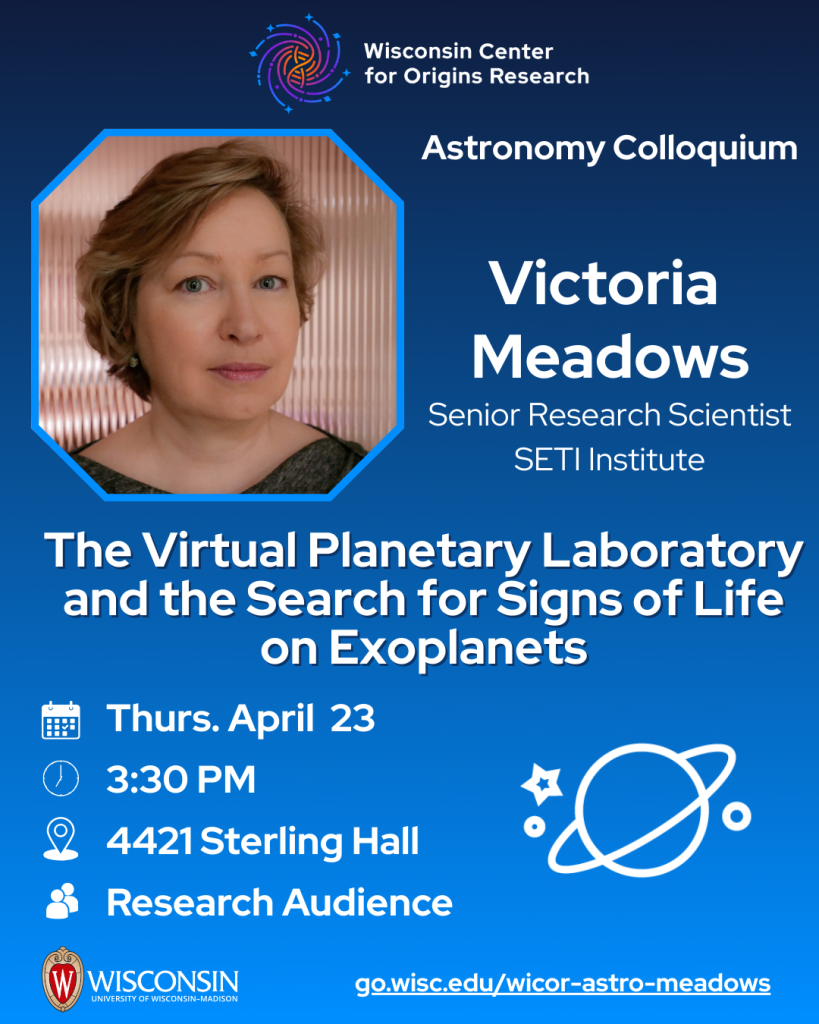
Title: The Virtual Planetary Laboratory and the Search for Signs of Life on Exoplanets
Abstract:
The Virtual Planetary Laboratory is a massively interdisciplinary research group that has been working since 2001 to put a strong scientific foundation under the search for signs of life on exoplanets. This exciting quest was identified as a high priority in both the Astro2020 and planetary science decadal reviews, and it is a key science driver for NASA’s next flagship space telescope, the Habitable Worlds Observatory. To search for life on an exoplanet we must look for potentially-detectable global impacts of life on its planetary environment, such as atmospheric gases released by metabolic processes. However, these biosignatures must be interpreted in the context of their planetary environment, to rule out planetary processes such as volcanism and photochemistry that may enhance, destroy or mimic a targeted biosignature. Consequently, to determine if a biosignature is more or less likely to be due to life, a broad range of information on planetary and stellar properties and processes must also be acquired. Depending on wavelength range, size, and whether ground- or space-based, different telescopes will be capable of advancing the search for life in different ways, ultimately providing synergistic pieces of a much larger puzzle. In this talk I will describe the potential capabilities for biosignature searches using high-resolution spectroscopy with ground-based telescopes and low resolution spectroscopy with JWST, and I will place these opportunities in the context of what might be possible with space-based telescopes over the next two decades.
Speaker Bio:
VICTORIA S. MEADOWS
Principal Investigator/Senior Research Scientist
Dr. Victoria Meadows is a Senior Research Scientist at the SETI Institute. She leads the massively interdisciplinary NASA Virtual Planetary Laboratory (VPL@SETI), which she started in 2001 with the goal of developing a scientific foundation for the search for habitability and life beyond the Solar System. Her research includes studying the present and past Earth as analogs for exoplanet environments, theoretical modeling of star-planet interactions, and using simulated spectra of exoplanets to understand how to best detect signs of life in a planetary environment. Dr. Meadows has served on numerous NASA mission concept development teams, including the Large UV Optical Infrared Telescope, and is currently a member of the NASA Habitable Worlds Observatory Community Science and Instrumentation Team. She was the Chair for the Exoplanets, Astrobiology and the Solar System Science Panel for the National Academy of Sciences Astro2020 Decadal Report. She is a SETI Institute Drake Award Recipient, a Fellow of both the American Geophysical Union and the American Astronomical Society, and Professor Emeritus at the University of Washington. She obtained her PhD from the University of Sydney.
Directions:
Sterling Hall is located at 475 N. Charter Street, Madison, WI, 53705. Utilize this campus map to find Sterling Hall: https://maps.wisc.edu/s/ckd3xmsx
Room 4421 is located on the 4th floor.
Accommodations:
WiCOR is committed to creating an inclusive and accessible event. If you need a reasonable accommodation, please contact Vanessa Orr, WiCOR Administrative Manager, at wicor@wisc.edu. All requests must be made by April 9. We will attempt to implement late requests but cannot guarantee they will be met.