
WiCOR Lecture – SP2027 – Frenkel-Pinter
Dr. Moran Frenkel-Pinter, Assistant Professor, Institute of Chemistry, The Hebrew University of Jerusalem
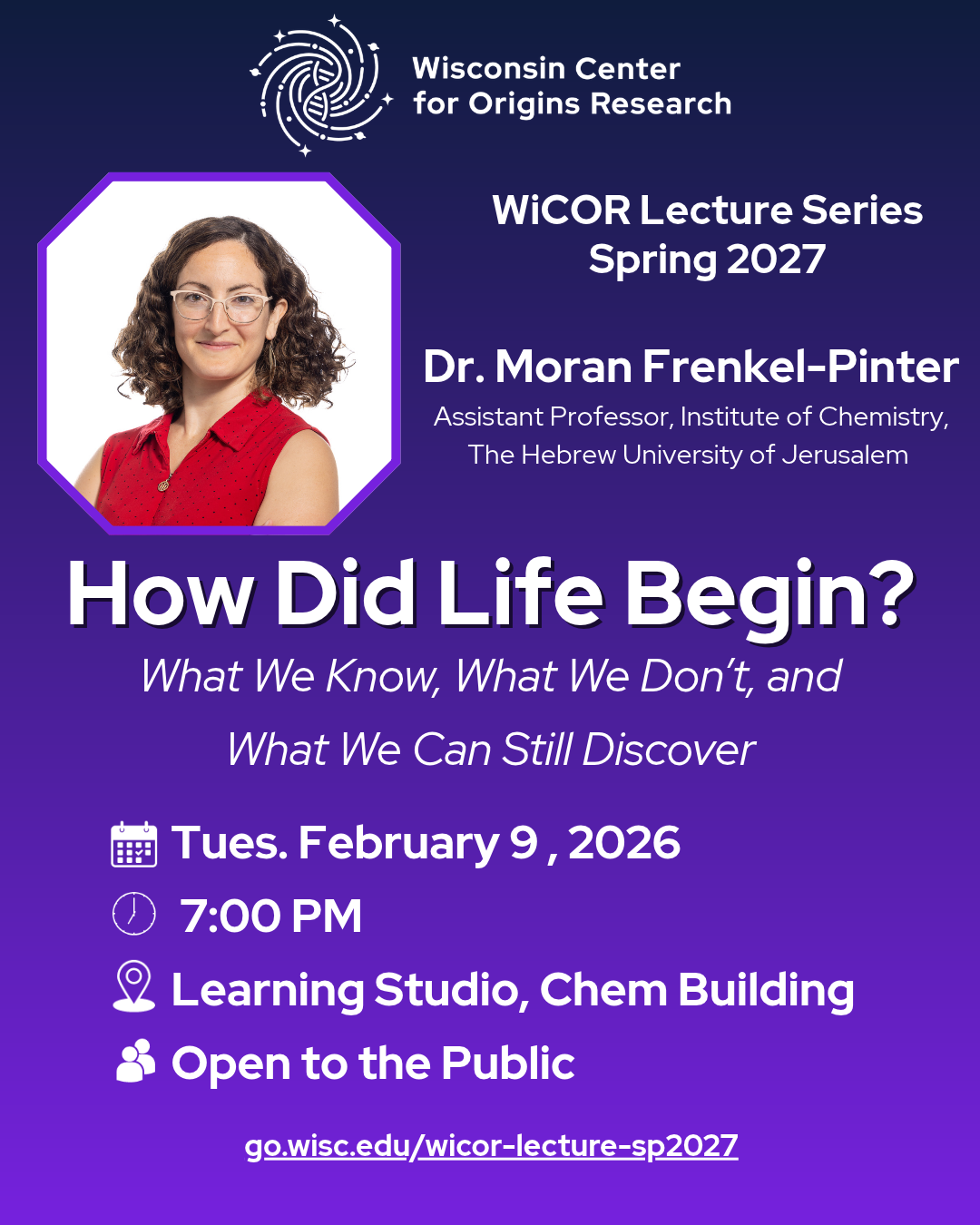
This event is free and open to the public thanks to support from the WiCOR Lecture Fund.
How Did Life Begin? What We Know, What We Don’t, and What We Can Still Discover
Abstract:
How did life emerge from nonliving chemistry? This is one of science’s most fundamental questions – and one of the most difficult to answer. We cannot travel back to the early Earth, and the geological record preserves only fragments of the chemistry that preceded biology. Yet laboratory experiments, observations of planetary environments, meteorites, and studies of modern biochemistry allow us to ask which chemical processes can generate the complexity, organization, and selection associated with life.
In this lecture, I will explore what we know about the chemical origins of life, what remains deeply uncertain, and how scientists study a transition that happened billions of years ago. We will consider how simple building blocks can form more complex structures, how chemical systems can organize and evolve, and why the search for life’s origins is closely connected to the search for life elsewhere in the universe. Rather than asking whether we can reconstruct one exact historical pathway, I will argue that a central goal is to uncover the general chemical principles that make the emergence of life possible.
Speaker Bio:
Moran Frenkel-Pinter is an Assistant Professor at the Institute of Chemistry at the Hebrew University of Jerusalem and Deputy Director of the Minerva Center for the Origins of Life. She received her Ph.D. from Tel Aviv University and conducted postdoctoral research at the Georgia Institute of Technology, where she was a NASA Astrobiology Postdoctoral Fellow. Her research focuses on chemical evolution and the origins of life, exploring how simple molecules could have formed increasingly complex and organized chemical systems before the emergence of biology. Her laboratory investigates prebiotic polymerization, molecular self-assembly, compartmentalization, and the chemical processes that may have driven molecular selection on the early Earth. She is the recipient of several awards, including the Stanley L. Miller Early Career Award, the FEBS Excellence Award, an ERC Starting Grant, and the Azrieli Early Career Faculty Fellowship.
Event Details
Directions:
The Learning Studio (1435) is on the first floor of the Chemistry Building and is accessible from the North Tower entrance at the corner of University Ave and N. Mills Street.
Accommodations:
WiCOR is committed to creating an inclusive and accessible event. If you need a reasonable accommodation, please contact Vanessa Orr, WiCOR Administrative Manager, at wicor@wisc.edu. All requests must be made by January 26. We will attempt to implement late requests but cannot guarantee they will be met.